
AN ECOLOGICAL FLOP https://kostekvisuals.com/wp-content/themes/movedo/images/empty/thumbnail.jpg 150 150 Kostek Visuals //kostekvisuals.com/wp-content/uploads/2024/10/KostekVisuals_logo_darkblue.png
I am writing this text not to lecture,
but to attempt to cultivate awareness, and encourage change through advocation,
for everyone considering a trip to a place like Sataya Reef.
A mix of scientific literature, and personal observations – This is an account of my experience
Kostek Strzelski
[15 min read]
The sign of where it goes wrong is when the world outside the self
is no longer the companion but the servant.
Barry Lopez1
english editing and proof reading: Kate Cullen
They hunt at night, taking advantage of the vertical migration of mesopelagic species. Diving to depths of up to 300 meters, they feed on squid, small fish, and shrimp. Nighttime activity in the open sea costs them a great deal of energy, so during the day they move to shallows and reefs, where they find safety and ideal conditions for sleep, rest, and socialization within the pod.
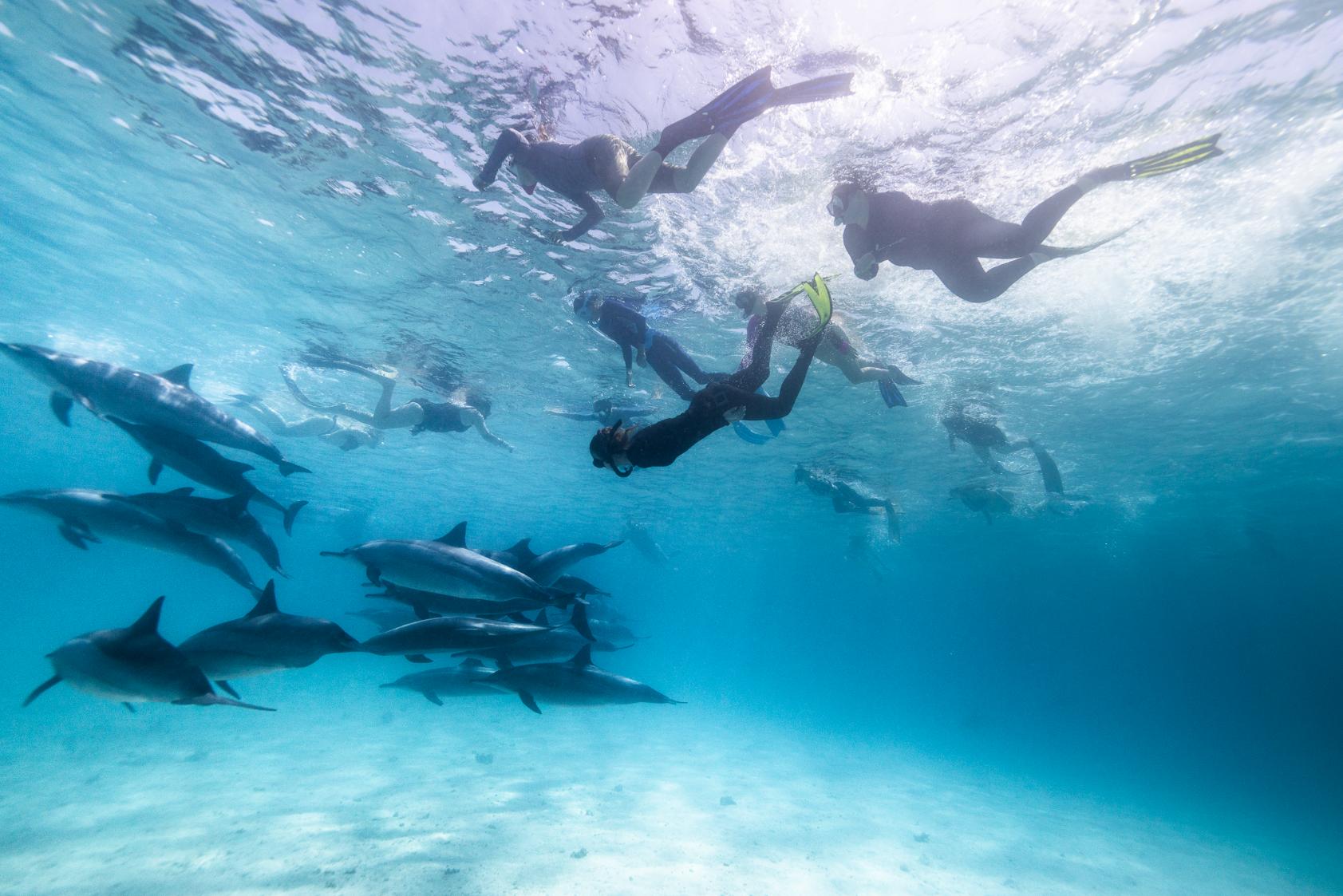
Spinner dolphins in the area of a very shallow reef, where they seek peace conducive to the development of their group behaviors. Photo: Kostek Strzelski / @kostek_visuals ©
1https://open.spotify.com/episode/7isKnOtYHY8HF8j0DhQTCO
Adam swims fast and dynamically. He is easy to recognize among the others because of a distinctive acquired feature. Adam has a straight, horizontal cut across his dorsal fin, thought likely caused by a boat propeller. People say he likes to swim close to boats. Adam is a spinner dolphin (Stenella longirostris), one of several dozen individuals that have chosen Sataya Reef as their resting grounds.
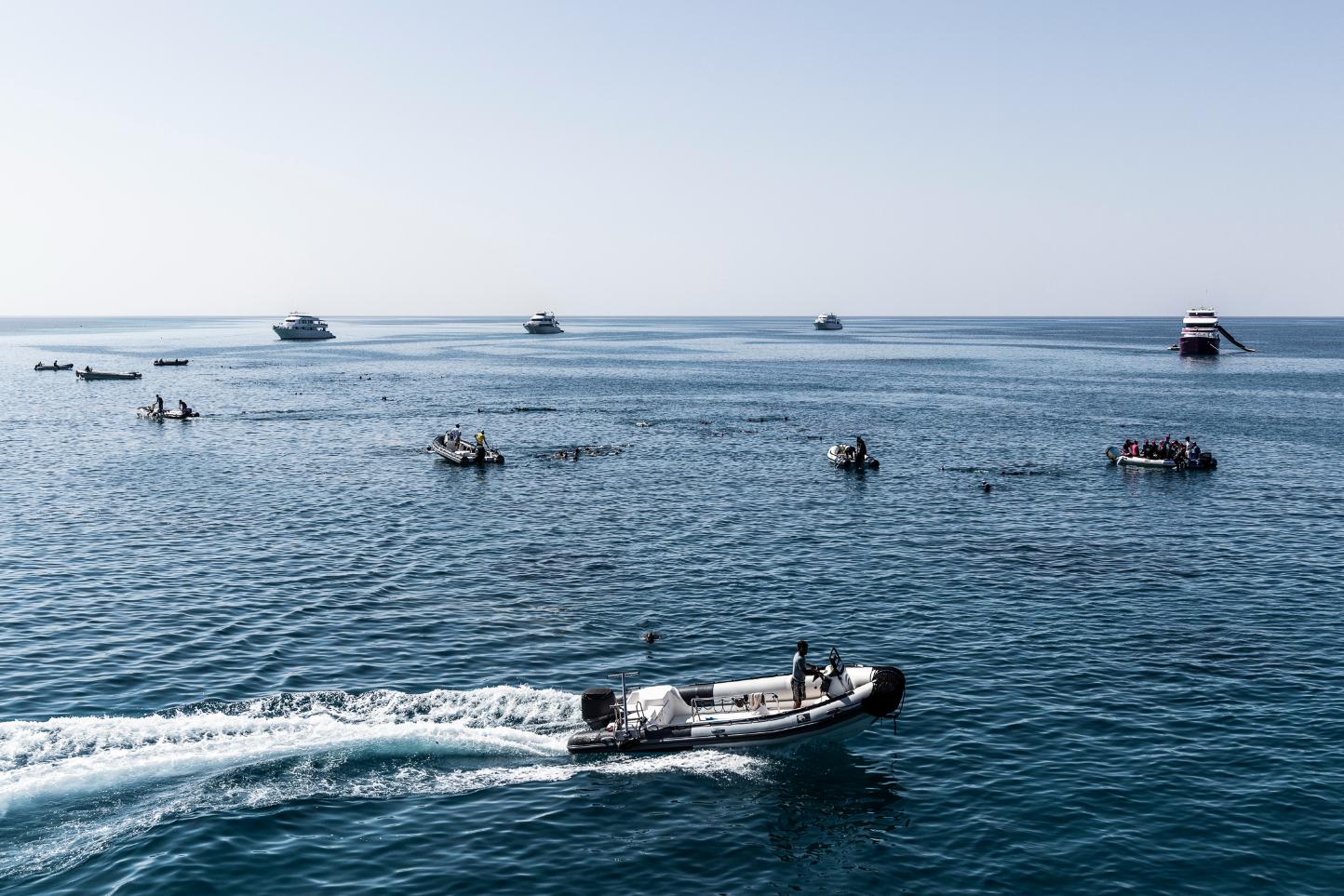
Motorboats: some bring people directly into the vicinity of dolphins, others right next to the areas of their greatest activity. In the photo, they are waiting for tourists to take them aboard and moments later release them back into the water — wherever one of the dolphin groups has moved. Photo: Kostek Strzelski / @kostek_visuals ©
Sataya lies off the western coast of the Egyptian Red Sea and, in the local variation of Arabic, Sataya refers to a plateau; describing the shape of the reef rising above the depths of the sea. Most of it has a sandy bottom, while its outer edges form an extensive coral reef wall. The average depth here is roughly 10–15 meters, snorkeling and freediving in such conditions is pure pleasure.
PEOPLE JUST WANNA HAVE FUN
Tourists come to Sataya for entertainment. I once visited – 3 nights and 4 days – aboard a 30-meter, four-deck, huge, luxury yacht; offerings available like a five-star all-inclusive hotel.
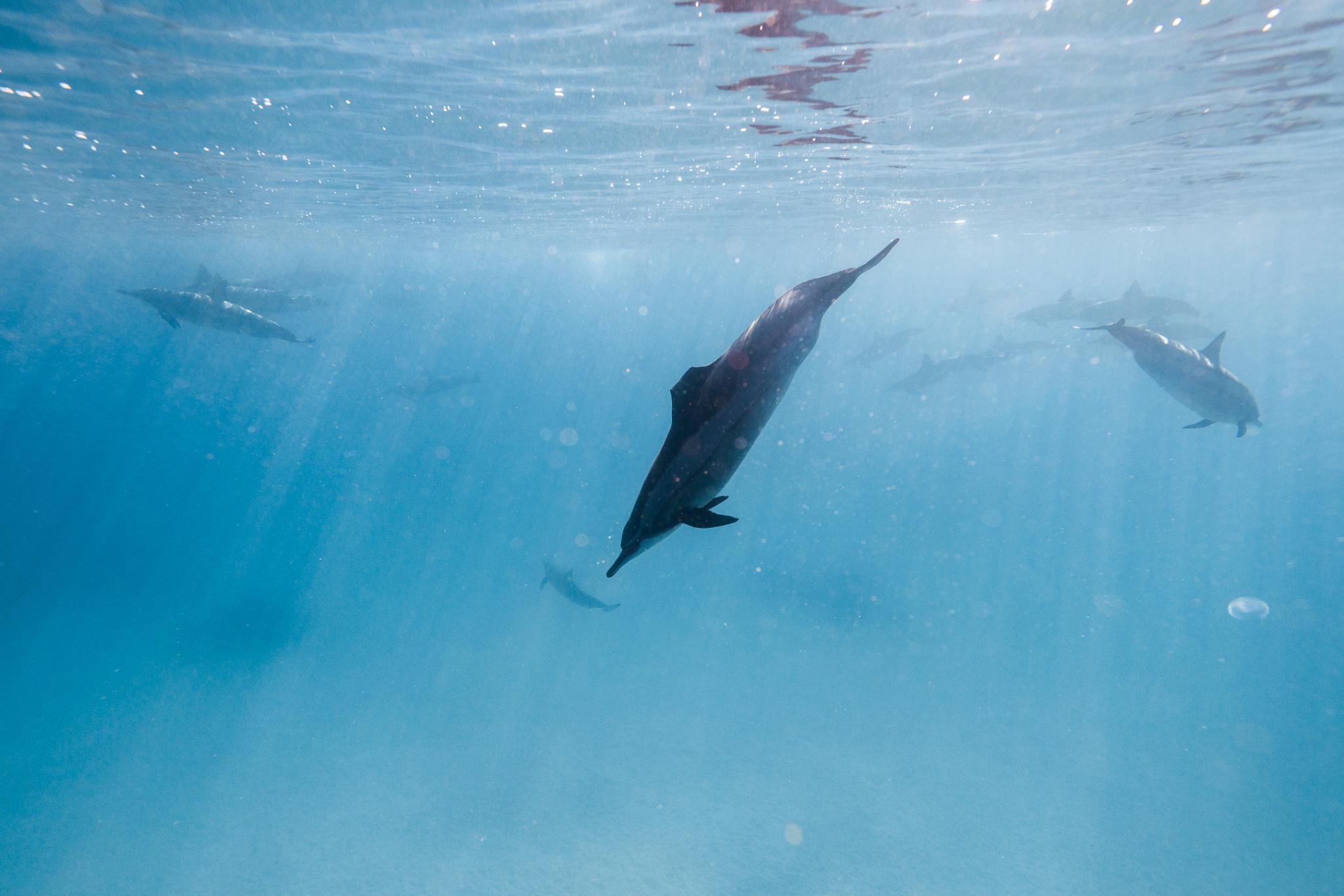
Adam. The dorsal fin functions much like a keel on a boat. It provides stability and allows for fast, sharp manoeuvres. At the same time, rich in blood vessels, it serves thermoregulatory functions, which is very important for these warm-blooded animals. Photo: Kostek Strzelski / kostek_visuals ©
I am a freediver and I specialise in underwater documentary, living most of my year across the water, in the Bedouin Town of Dahab. Dahab is to freedivers a playground. We train and dive there, while satisfying our love of the underwater, and all things “Ocean”. Here, within the community, now aptly called “Dolphin Trips” to Sataya are gaining in popularity. I came to Sataya to photograph participants on their trip, while swimming with dolphins. I usually stay away from the topic of wildlife safaris but I had never before been to a place where there was a guarantee of encountering dozens of dolphins. Yes, of what I knew about wildlife tourism, part of me was a little apprehensive. But the thought of experiencing it was tempting. On site, through my assignment and the conversations that followed, something entirely different moved me than what I saw on social media. A whole new world appeared. Here I share with you what I discovered..
THE DAILY LIFE OF DOLPHINS AND HUMAN PRESSURE
Traffic. A lot of it. Destructive.
Endless groups of snorkelers, scuba divers and us free. Makeshift anchorages, thick ropes ending in loops, that are snagging and pulling off corals. Water that smells and tastes like fuel, in it a mixture of waste, and gasoline. And clicks of dolphins, barely audible as they are constantly drowned out by taxiing motorboats; one after another delivering more tourists in pursuit of dolphin pods.
Sataya is home to spinner dolphins (Stenella longirostris, Delphinidae). For a behavioral perspective, they are among the best-studied cetacean species in the world. Most current knowledge comes from studies of Pacific populations in Hawaii, of which populations have shown a decline in their numbers since the 1990s, thought to be caused by increasing tourist pressure on resting habitats.
In Brazil, in the Fernando de Noronha archipelago, oceanographer José Martins [leading specialist, researcher of spinner dolphins, founder of Spinner Dolphin Project undertaken by the NGO Spinner Dolphin Center] has spent years studying the impact of tourism on local dolphins populations. In an effort to know more, I reach out to him. Amongst many scientific papers, he shared:
“Spinner dolphins treat Fernando de Noronha as a peaceful refuge: they rest here, reproduce, and care for their young. When tourist boats appear in these same places, their daily rhythm is easily disrupted. Noise and movement can affect the animals’ behavior and discourage them from returning. Growing pressure from humans can quickly turn into a real threat.” 2
2 Interaction of spinner dolphins (Stenella longirostris) (Cetacea, Delphinidae) with boats at the Archipelago of Fernando de Noronha, Brazil MARINA C. TISCHER, JOSÉ M. DA SILVA JÚNIOR, FLÁVIO JOSÉ DE L. SILVA https://golfinhorotador.org.br/publications/Spinner_Interaction_Boats_FN.pdf
In Fernando de Noronha, just like Egypt, observing these animals is one of the main tourist attractions and of major economic importance for the local inhabitants.

Red Sea offers stunning views not only underwater. Dahab is no exception. Mountains overlooking the Gulf of Aqaba can put one into a right perspective – feeling like a servant of nature and full of respect for it. Photo: Kostek Strzelski /@kostek_visuals ©
The lifestyle of spinner dolphins does not differ according to where they live. After years of evidence in Hawaii, the NOAA (National Oceanic and Atmospheric Administration) have now introduced clear prohibitions to protect the dolphins, namely:
- approaching or remaining within 50 yards (approx. 45 meters) of a Hawaiian spinner dolphin;
- swimming within 50 yards of a dolphin;
- allowing a vessel, person, or other object to approach or remain within 50 yards of a dolphin;
- cutting across the path of a dolphin or placing a vessel, person, or other object in the dolphin’s path in such a way that the animal itself approaches within 50 yards of that vessel, person, or object.
HEPCA, is an Egyptian NGO.
An organisation that employs around 30 people in its environmental and scientific departments, including researchers and scientists specializing in various fields. Groups regularly join from international universities for research stays lasting up to six months.
About HEPCA – Head Office Director, Nora Boumhaoud
Professor Mahmoud Hanafy [Suez Canal University, scientific advisor & member of HEPCA], recognized marine biologist working for the Red Sea National Parks, explains that as a non-governmental organization, HEPCA focuses on environmental protection. With a flagship conservation project at Samadi reef, he says the reef has become a symbol of the problem of wildlife tourism”, noting our greatest challenge – reconciling the need to protect the coral reef, and its inhabitants, with humanity’s desire to admire the beauty of nature. Humans can interfere with underwater life, to limits the ecosystem cannot bear. What attracts tourists may be destroyed precisely by them coming.3
3 https://www.hepca.org/projects/conservation/samadai-project
HEPCA have implemented a guarded regulatory project at Samadai Reef [55 nautical miles (100km) North from Sataya].
Since 2014, they have developed three additional protection plans for areas, based on the same model. But many other places in the Red Sea still lack both sufficient staffing and an effective enforcement system, especially in reefs as remote as Sataya.
About HEPCA and Sataya reef protection plan implementation – Professor Mahmoud Hanafy.
Foam suspended on the water caused by discharge from a vessel at the reef. When I noticed that some liquid was being poured out through one of the outlets in the hull, I asked the boat operator what it was. I was told I was making an unnecessary fuss and that it was only the result of water being churned by the propeller of a motorboat. I objected, pointing out that no motorboats had been operating that evening. Then, to confirm the operator’s words and at his command, a boat appeared that with several maneuvers quickly dispersed and eliminated the foam I had noticed. To my surprise, the satisfied operator said: “See, there’s no foam anymore.” Photo: Kostek Strzelski / @kostek_visuals ©

While processing my experience live on the boat, I was trying to make sense of it all. I tried to discuss my concerns of our presence with several people, but was met with; “If they want to, they’ll just swim away,” and “they like to play and swim with people.” During Mr José Martin’s studies in Brazil, it was found that the presence of tourist vessels changed the animals’ movement patterns – they moved faster, fled more often into the open sea, split into smaller groups, or changed direction. The more boats nearby, the more dolphins had to adapt their behavior, abandoning natural activities such as long dives or swimming along the bow of a boat. Even a single boat clearly modified the pace and manner of the animals’ movement, demonstrating that tourist pressure has a real impact on the daily life of these pods.4
4Os Golfinhos de Noronha (The dolphins of Noronha) Textos e fotos: José Martins da Silva Júnior
https://golfinhorotador.org.br/publications/Livro_Golfinhos_Noronha.pdf pages 148 – 151
A firm conclusion: dolphins change their natural behavior under the influence of human presence. Spinner dolphins choose such shallow reefs as places to rest and sleep in order to protect themselves from predators, like sharks. Calmly moving underwater, surfacing from time to time to breathe. If disturbed by boats, given the number of such shallow areas in the Red Sea is limited, they have nowhere else to flee.
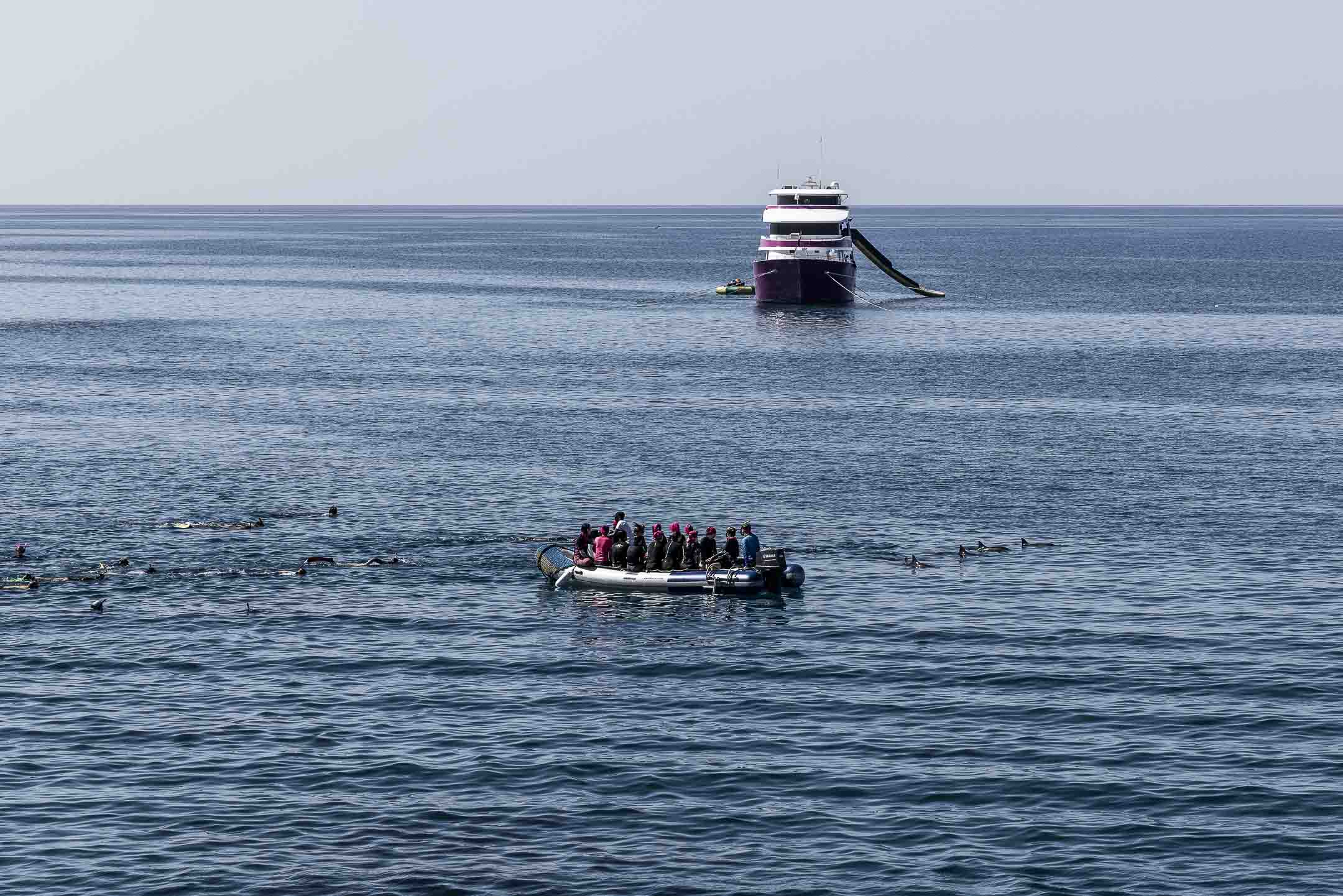
Spinner dolphins’ dorsal fins, a group of tourists in the water chasing a pod, and observers on a boat. Photo: Kostek Strzelski / @kostek_visuals ©
“THEY’RE PLAYING WITH US!”
In the daily life of dolphins.
The animals rest close together, moving slowly near the bottom in compact groups. Young remain beside their mothers, nursing and receiving gentle care, while adult dolphins copulate mainly in the morning and before leaving the bay, produce loud whistles and clicks.
Natural physiological behaviors such as defecation and vomiting are also observed. Young dolphins spend time playing – rolling, chasing each other, playing with seaweed, fish or other marine creatures; imitating adult behaviors.
For defensive behaviors, spinner dolphins produce loud pulsating sounds, adopt S-shaped postures, rub and stroke their bellies, and open their mouths wide. In the presence of reef sharks, these behaviors are accompanied by charges from groups of males.
Through Mr Martin’s Brazilian research team, they noticed that spinner dolphins are cautious around large sharks, sharing how on one occasion all groups – around 350 individuals – suddenly left the bay when a massive 2 meter long reef shark appeared near the surface.
While at Sataya, practically every time we approached dolphins, we first observed small and larger pods calmly gliding, and then, with the sudden presence of humans crossing, immediately their behavior adjusted…
Compact formation was lost, breaking into groups of threes and fours. They dynamically changed direction, and accelerated sharply over short distances. They surfaced quickly, and just as fast, dove again. They approached people much more closely, then abruptly swam away. The same S-shape defence pattern. Tourists, capable of it, dove after them.
So, do dolphins like to play with humans? Does engaging in conscious interactions bring them pleasure?
Egyptian Professor Mahmoud Hanafy answered me very clearly:
“There is no scientific evidence confirming that dolphins are inclined to engage in play with humans”.
Then why do so many people interpret this behavior that way?
Do we blindly believe the sea-stories we are told, mapping human emotions to an animal in support of manifestation of our ego, searching for justification for our desire to swim and dive with dolphins?
Are dolphins playful? – It is just an observation, says Professor Mahmoud Hanafy.
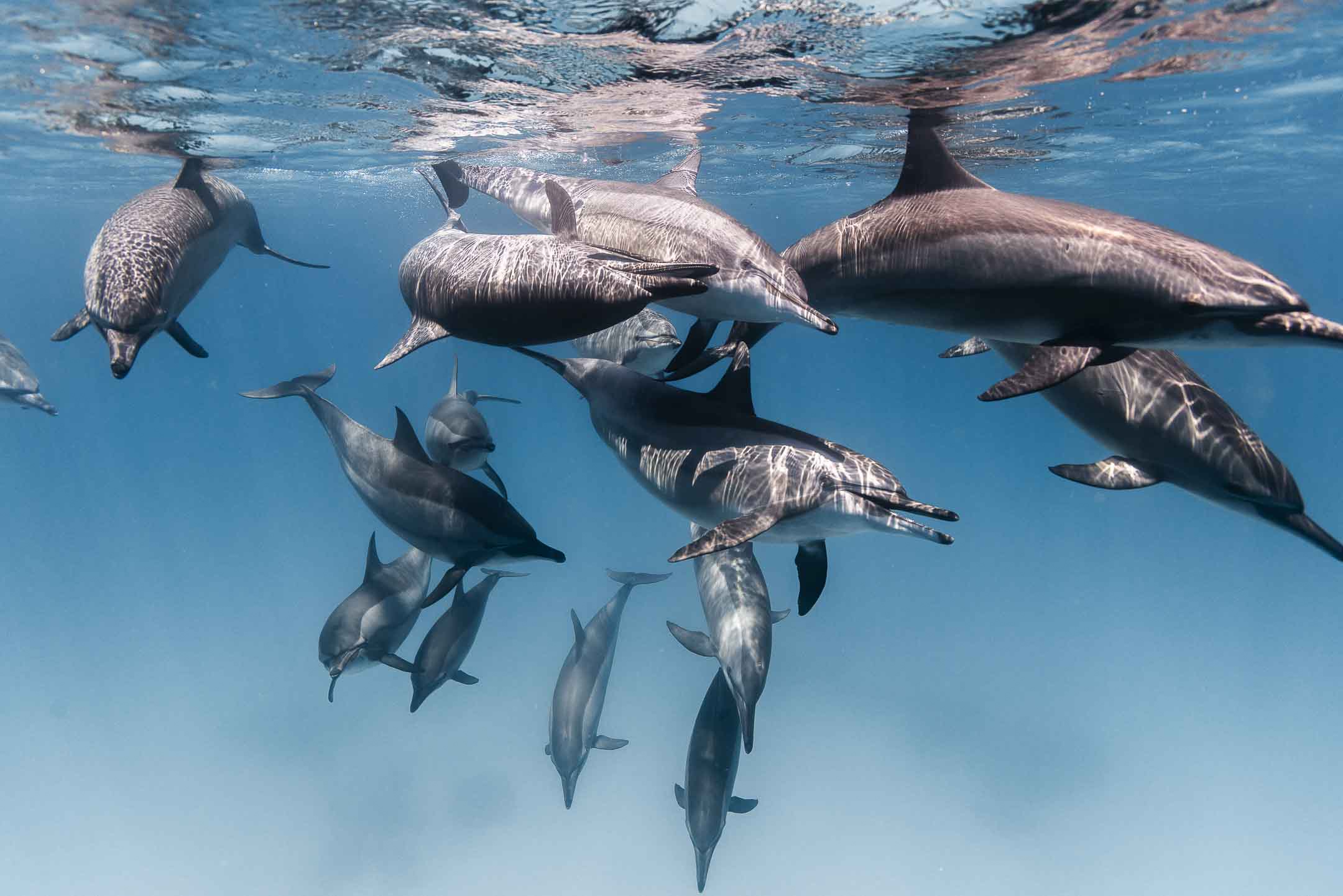
Spinner dolphins from Sataya Reef. A photograph that falsifies reality. Behind my back are dozens of people and boats generating noise and pollution. Photo: Kostek Strzelski / @kostek_visuals ©
WHY MUST PLACES LIKE SATAYA OR SAMADAI BE PROTECTED?
In freediving, while practicing this sport, many people dream of a close encounter with wild marine nature. In Dahab, the community is very strong, supportive, and full of individuals declaring deep love for the sea. What could be a more beautiful fulfillment of that love than meeting a wild dolphin, eye to eye, in its natural environment?
I’ve received that luck once in my life. Two bottlenose dolphins swam to me, circled three times, and returned to patrolling the reef. The encounter, lasting just over a minute, took place in the heart of Dahab, on a section of reef called Eel Garden. Spontaneous and unexpected.
At Sataya Reef, with the certainty of encountering entire pods of dolphins, you do not need luck, coincidence, or being in the right place at the right time… you only need money. More and more, freedivers want to share the experience of swimming and diving with dolphins by organizing trips to Sataya. Beautiful images portraying us surrounded by dolphins appear online, accompanied by emotional accounts and descriptions of the magic of the experience, the feelings; the tears of happiness that accompany it. Encounters with dolphins at Sataya Reef are long. Tens of minutes turning into one or two hours. Jumping into the water a second, third, fourth time.
If we stay overnight at the reef, the next day we repeat the routine. Are we taking advantage of an opportunity or actively exploiting the natural environment to satisfy our own desires?
A group of scientists, led by Maddalena Fumagalli from the University of Otago in New Zealand, show in studies conducted between 2006 and 2014 that in the Red Sea, that although tourism did not force dolphins to abandon their bays, its true without many alternative resting places, tourist pressure may affect their reproduction and survival; and like Hawaii, would contribute to a decline in population numbers.5
5 Tyne JA, Johnston DW, Christiansen F, Bejder L. 2017 Temporally and spatially partitioned behaviours of spinner dolphins: implications for resilience to human disturbance. R. Soc. open sci. https://royalsocietypublishing.org/rsos/article/5/4/172044/87593/Behavioural-responses-of-spinner-dolphins-to-human
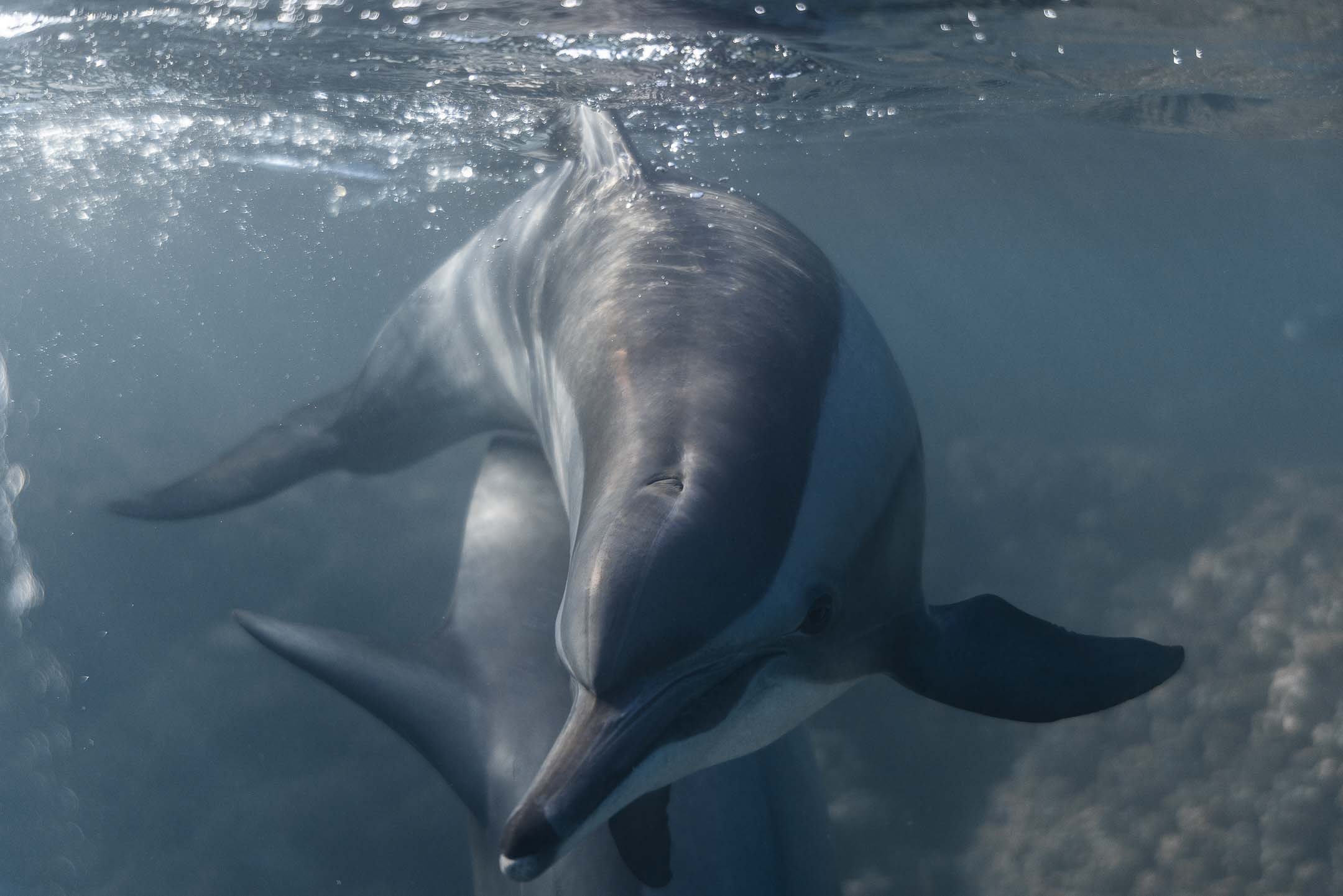
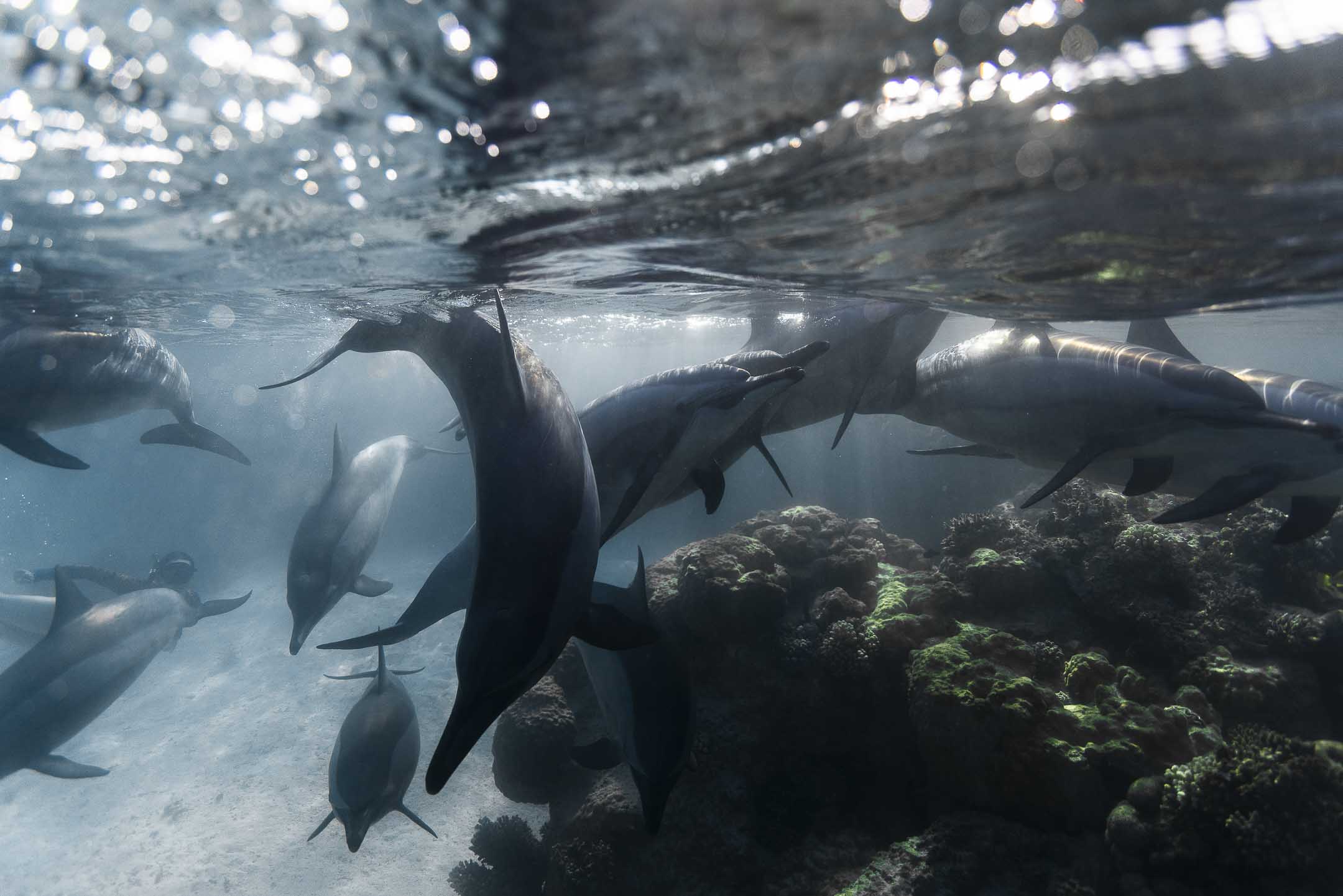
Such close physical contact with a group of dolphins should never have happened to me or to the other members of our group of over a dozen people. I took advantage of the opportunity for unique close-ups, but I am not satisfied with these photographs. Cornering dolphins in such shallow water left me deeply ashamed. Photo: Kostek Strzelski / @kostek_visuals ©
Professor Mahmoud Hanafy mentions that all dolphin resting sites in the Red Sea are now considered critical habitats and should be covered by special management plans. At Samadai Reef, since protection in 2004, only three violations of regulations have been recorded over more than two decades. Although online reviews count for more examples of human weakness, this is definitely a success story for Samadai; a now world apart from Sataya Reef, a depressing circus of where there are no rules.
Resting areas and Samadai Reef regulations.
Tourism generates significant income, but protecting the natural resources on which it depends is crucial. Professor Mahmoud Hanafy states that some tour operators are committed to this, others remain neutral – but the real problem lies with those who simply do not care.
On the willingness to follow regulations at Samadai Reef – Professor Mahmoud Hanafy.
Dolphins are being disturbed, and with the involvement of most tour operators directly interested in economic gain, with the tourists coming to swim at “any cost”; it shows how difficult a task awaits the community that wants to care for the health of dolphin populations in the Red Sea, too.
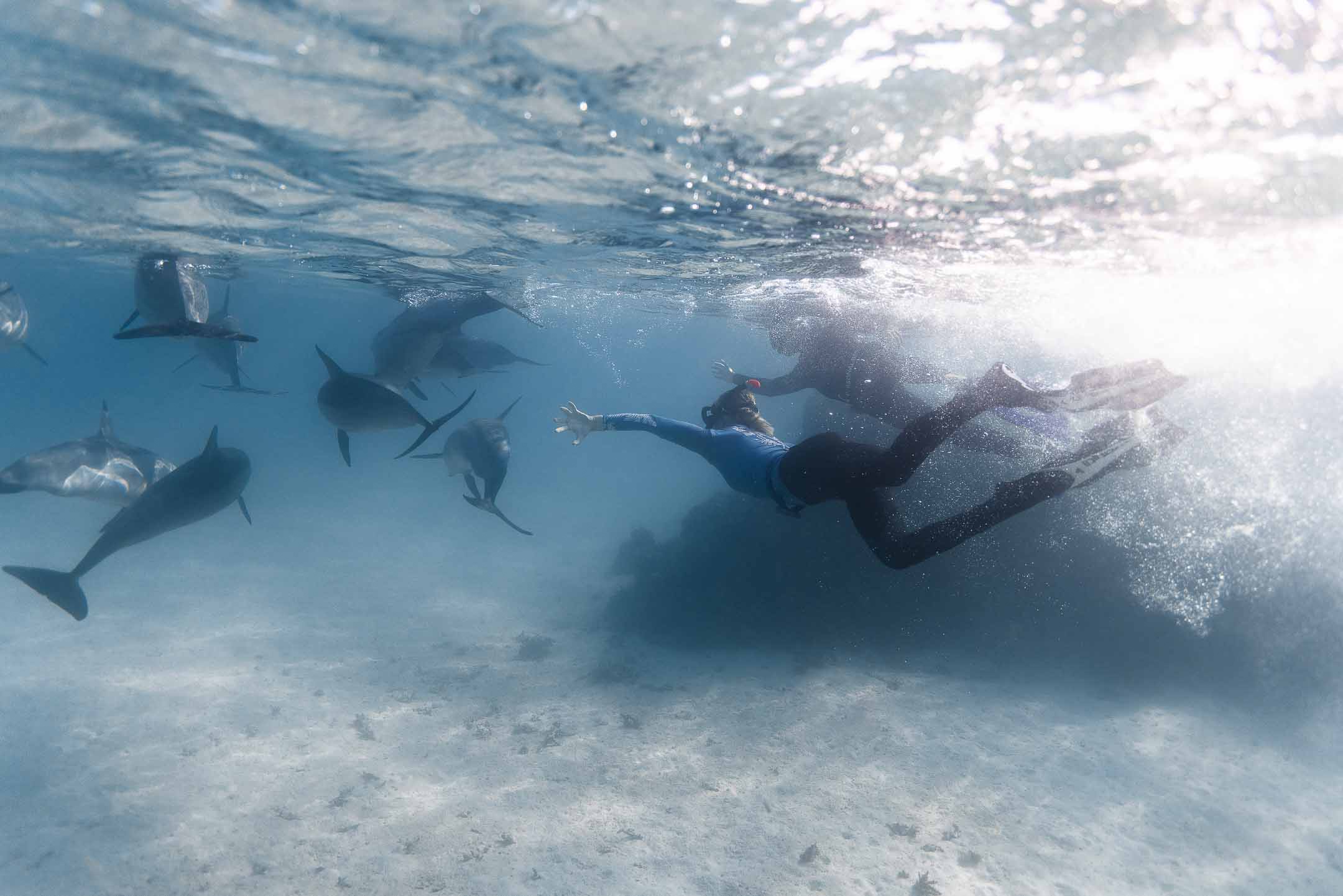
Tourists in pursuit of a pod. Photo: Kostek Strzelski / @kostek_visuals ©
HEPCA has developed a dolphin protection plan for Sataya Reef, based on 18 months of research, and in cooperation with the Egyptian Environmental Affairs Agency. Mohamed Ismail, senior assistant at the Faculty of Science of Port Said University, who under the supervision of Professor Hanafy, has proposed appropriate conservation regulations.6
6 https://www.hepca.org/news/a-management-plan-for-satayah-reef#
Within the framework of the project, seven zones with their own regulations were designated, ensuring that the dolphin pods of Sataya would not be exposed to such strong impacts from human presence.
- Zone A1 and A2, proposed absolute protection and a complete ban on human presence with dolphins.
- Zones B1 and B2 would allow limited human presence, for example for scientific purposes, with a complete ban on boats.
- In zone C, defined as a swimming and snorkeling zone, with permission to swim, dive, conduct research, and use boats traveling no faster than 10 knots per hour.
- The final zone proposes relocating the anchorage for large boats away from the vicinity of zones A1, A2, B1, and B2.
During my stay at Sataya, none of the tour operators or boat captains followed these proposals. And what struck me most was that zones A1 and A2, the “complete ban”, are precisely the zones where people are very often present; currently contains the highest number of mooring spots for large tourist boats; a sight clearly visible on Google Maps satellite imagery.
Samadai Reef opening hours explained – Professor Mahmoud Hanafy
EGO/ECO-DRIVEN DIVING
While at Sataya, painfully, I felt as though I were in a zoo. Yet the feeling of helplessness slowly transformed into concrete reflections. What should be introduced at Sataya Reef to make encounters with dolphins less human focused? I wonder, how much depends on consumers and the decisions we make, and how much on those who hold real ability to lobby authorities for enforcement of rules that have already been drawn up?
Even with Samadai Reef success, it seems that true agency lies on both sides, in the hands of us all. With growing interest in trips to Sataya, the freediving community, of which I myself am a part, has a very important role to play. We are those who love the sea and those who often set trends. The message we create on social media about Sataya Reef and many similar places around the world has enormous significance for conservation. We need to realise, an intimate trip on a small sailing yacht with only a few people can also harm dolphins, knocked on from attractive content published online, drawing hundreds more tourists to this place, not necessarily as aware as we are.
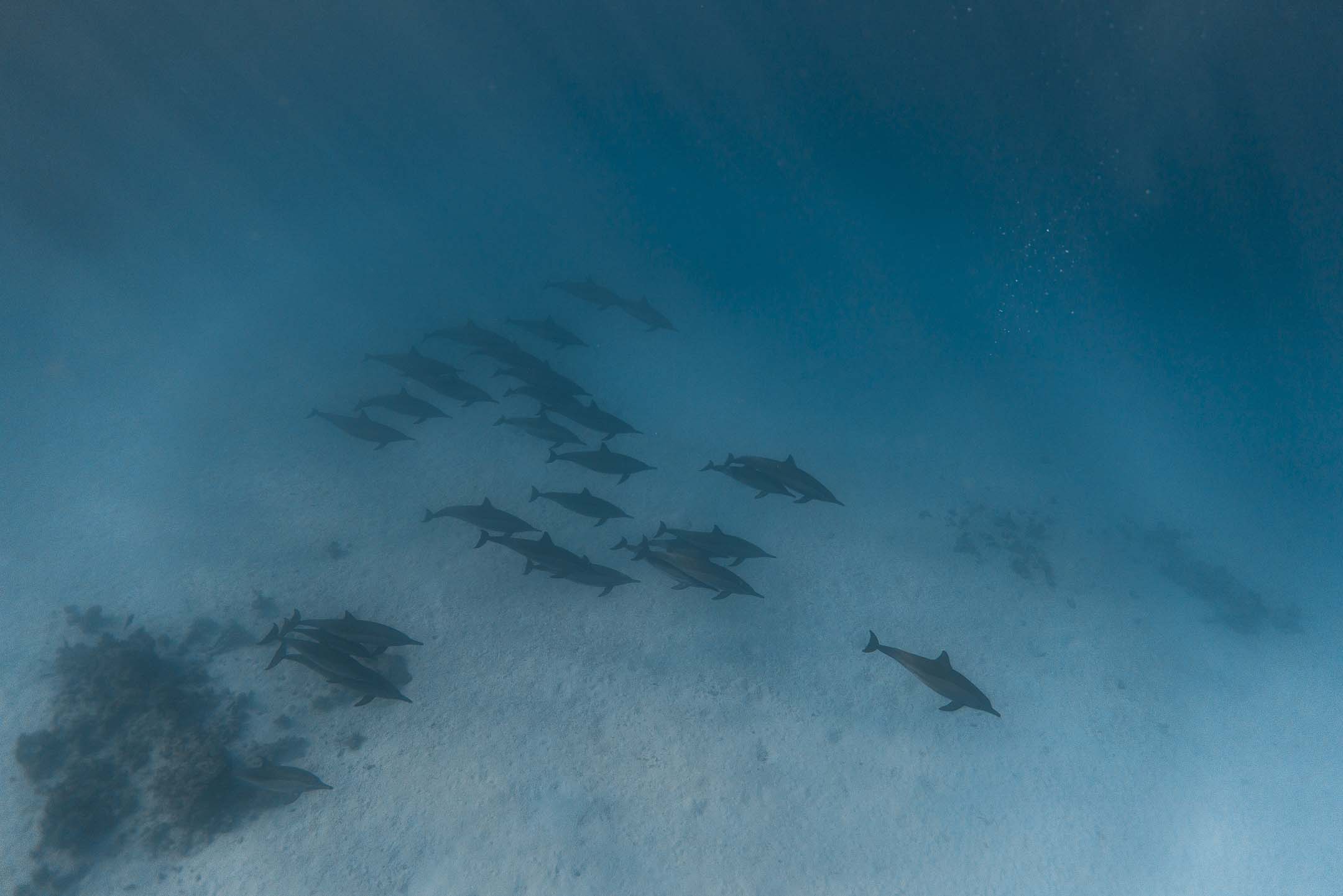
A pod of spinners, gliding without disturbance. Photo: Kostek Strzelski / @kostek_visuals ©
And such, in Egypt and other places around the world – this type of tourism forms an almost undisputable pillar of the local economy; is there room for a sustainable approach and for understanding and respecting rules developed by scientific teams?
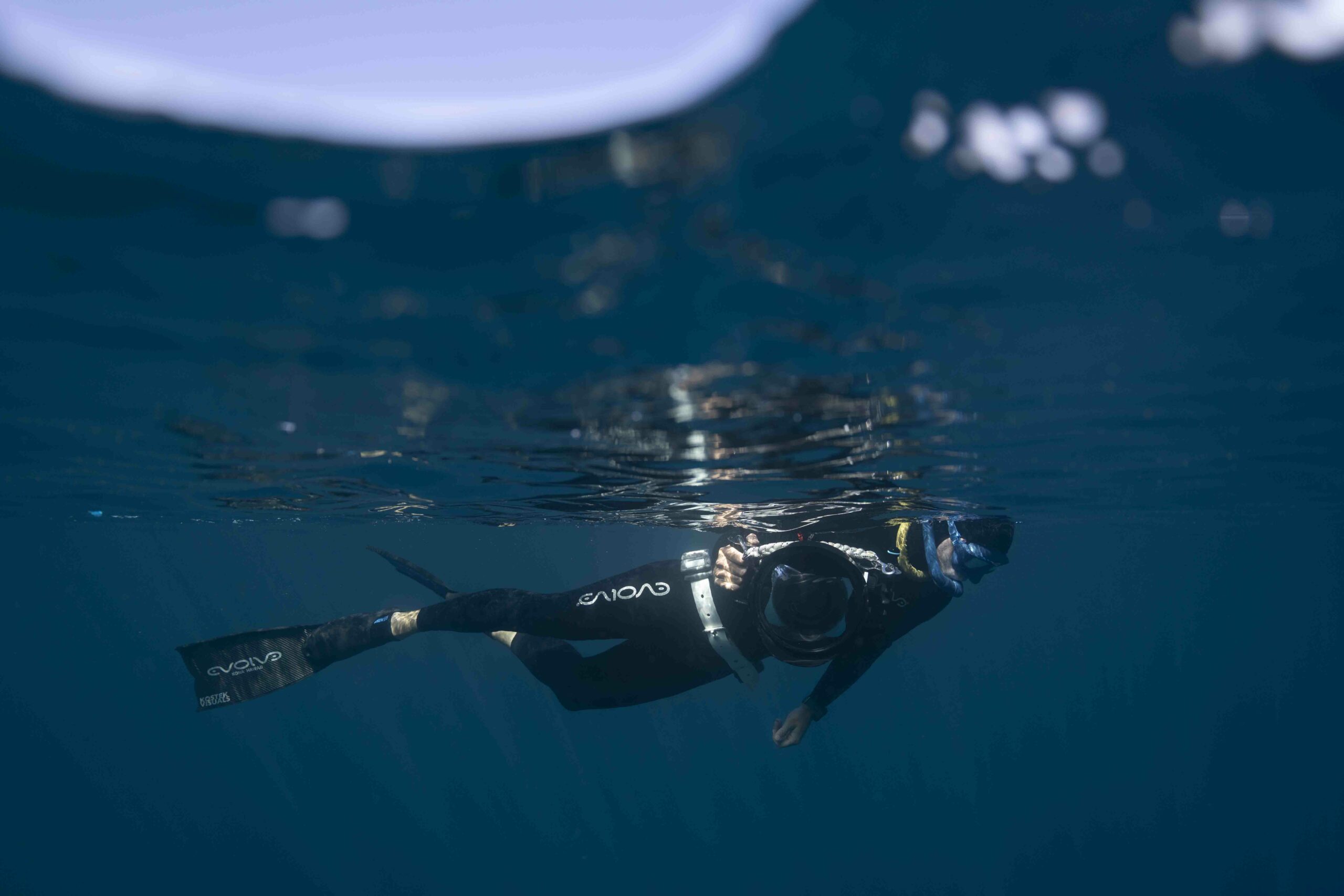
Me taking a swim in the waters of the Red Sea. Photo: Nanna Kreutzmann©
Adam’s severed dorsal fin is only one symbol of the mark humans can leave on fragile ecosystems. From conversations with freedivers regularly traveling to Sataya, I know that we tend to distance ourselves from the problem; pointing to local governments and decisions at high levels as the source of it.
At the same time, we search for loopholes and resort to self soothing tricks: “I swim with dolphins at 6 a.m. and I’m alone with them in the water”. A time disturbing their crucial resting after a night full of hunting. Sometimes we suffer anthropomorphization; allowing ourselves to think that dolphins are experiencing existence just like us. Often leading to incorrect interpretations of animal behavior – what makes them happy, what calms them etc – and thus in the end, we enjoy ourselves while a lot of times causing stress to dolphins.
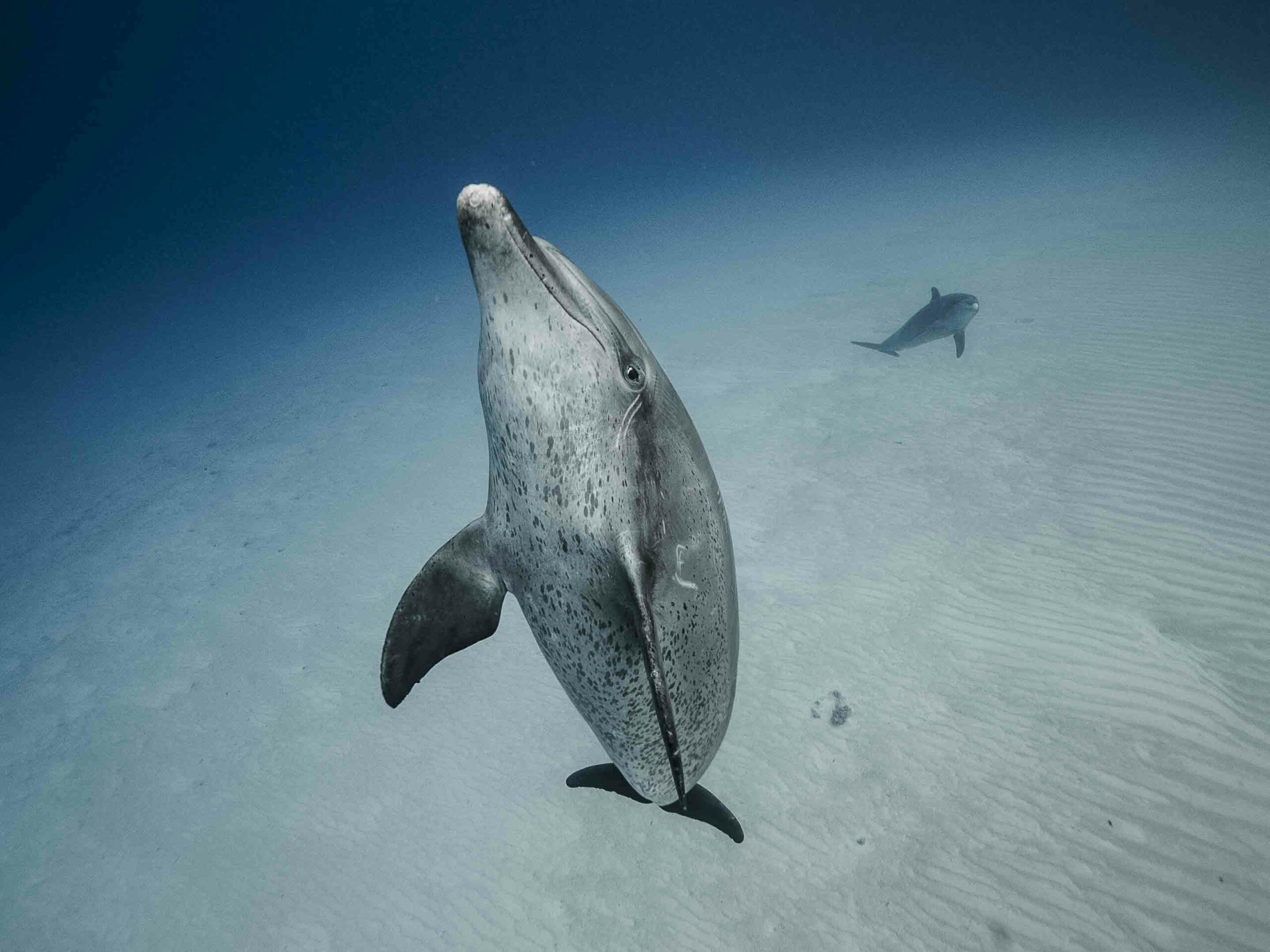
Unexpected encounter with bottlenose dolphins in Dahab. Photo: Kostek Strzelski / @kostek_visuals ©
Access to scientific research shows humans pose a negative impact on dolphin populations and habitat quality. As ocean lovers, what examples can we lead? Can access to this information can already mobilize us to work actively for marine conservation?
Can we put down the idea that if local governments have not yet regulated tourism that it is not our problem to hold? Can we work with the natural life cycle, and advocate for research based grassroot change?
Can we be a strong voice? Encourage tour operators to follow basic rules proposed by scientific communities? Could we keep distance and ask ourselves what is natural and good for wild animals? Can we care more about them, and less about our Instagram?
Want it or not, bringing or influencing clients for encounters with the wild marine world, we absolutely take conservational responsibility for places like Sataya.
The question left simple.
To protect what we love, and retain the legacy of our natural world for generations to come; can freediving lead the way – stop the Ego, and drive instead from Eco?
That’s what I ask. A conversation I hope continues.
Acknowledgments to:
Carlos Diezel, who connected me with Jose Martins.
Mr Martins for overwhelming me with hundreds of pages from various scientific journals and providing many examples, presenting valuable scientific data used in the above text.
To the HEPCA team, led by Professor Mahmoud Hanafy and Nora Boumhaoud, for their warm communication and willingness to talk about Red Sea spinner dolphins.
To everyone who listened to me and shared my feelings about mass tourism at Satayah Reef, encouraged me to write, and to
finish this text.
Special mentions to:
Kate Cullen for editing and proof reading of the english version of this text, giving it a much-needed touch of true environmental journalism.
Klaudia Hajto for editing and proof reading of a polish version of this text and for leading me into a right track.
And of course, to the immense and heartfelt support of my wonderful wife and friend, Kate Strzelska; continually dealing with my frustrations about how far human actions are from, and contrary to nature; and for always reminding me how important this was, encouraging me to work even when I had doubts.